
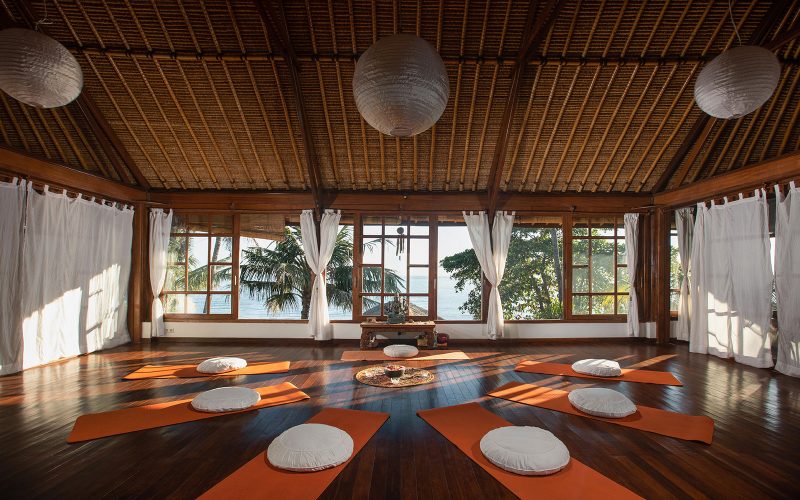
Yoga is becoming more and more popular around the world. In addition to the most unusual yoga styles, there are also countless yoga studios and stores, especially in the western world. Yoga has become a trend. But very few people know the deep meaning behind it. Social media conveys the image that the aim of yoga is to perform difficult poses in the trendiest leggings. This leads to the misconception that only the most flexible and trained can practise yoga.
However, the physical aspect is only a small part of this holistic practice. Our body is merely a tool to create an even flow of energy and to recognize the connection between body and mind. Yogic practices help us to create space in our body and mind so that energy can flow freely. When our mind is calm, love and peace can spring from within. So the goal is to love yourself, be love, spread love and live a happy and fulfilled life.
At Prana Veda Sanctuary Bali, we practice traditional yoga with a holistic approach to create and maintain balance between body, mind and soul, and to break through the “protective walls” we often build around our hearts.
We lead a life in community according to yogic and Ayurvedic principles and practice mindfulness, awareness and loving kindness.
What does the word yoga mean?
Yoga comes from Sanskrit, the ancient language of India, in which all Indian philosophies and yogic texts are written down. The original yogic text was written by the holy teacher Patanjali, who composed 196 short texts more than 2500 years ago.
The meaning of the word yoga translates as union, i.e. the merging of several into one.
But what does that mean? What is being united?
There are different levels of association.
On the one hand, it means the unification of people. It is about practicing yoga in groups, meeting without judgment, learning to be egoless and about compassion. It is important to realize that we are all part of something bigger and to focus on the good in ourselves and in others. We start the yoga practice with “Namaste”. This translates as “The divine in me greets the divine in you and I know that we are one.”
This idea can also be extended to the body and mind. Practicing yoga holistically means pursuing the goal of self-development and self-awareness. The tools we have for this are our body and our mind. The aim is therefore to create balance between these dimensions. Physical imbalances often have mental causes and vice versa. It is therefore important to understand that body and mind correlate with each other and that balance must be established on both levels. Conscious breathing is a tool for connecting body and mind and arriving in the here and now.
Secondly, it is about the union of the individual soul with the cosmos. This union makes it possible to achieve completeness, fulfillment, happiness, unconditional love for oneself and others, freedom and peace, which leads to enlightenment or awakening.
So in a nutshell, what is the aim of yoga?
To summarize, the aim of yogic practices is to balance the flow of energy in our body, allowing us to direct our attention inwards. By observing our thoughts, we become aware of them, reflect on them and have the opportunity to let go of old beliefs and gain new perspectives. Through the balance between body and mind, we reveal our true nature, find our way back to our basic trust and ignite our self-love, the basis of all love.
What does yoga involve as a holistic practice?
Yoga is a philosophy of life. It is about self-reflection, self-awareness, awareness, mindfulness, maintaining physical and mental health through asanas (yoga poses), meditation, pranayama (yogic breathing), cleansing practices, chanting mantras, nutrition and Ayurveda. Yoga therefore follows a holistic approach and physical asanas are only one part of it.

